Your body churns out rich red blood that carries nutrients and oxygen to a secluded outpost, producing skin, muscles, and bone daily. It also sends nerve signals hopping along thousands of leagues of brain and body pathways while formulating chemical messengers that shuttle from one organ to another issuing instructions that help sustain your life.
Do you know that your body can only achieve all this with the help of some raw essential materials which it cannot manufacture on its own in a sufficient amount? These essential materials include at least 30 vitamins, minerals, and dietary components.WHAT ARE VITAMINS AND MINERALS?
Vitamins and minerals are essential nutrients because they perform hundreds of roles in the body and eating a healthy diet remains the best way to get sufficient amounts of vitamins and minerals with emphasis on fruits, vegetables, whole grains, beans, legumes, and low-fat protein. Vitamins and minerals help shore up bones, fortify the immune system, heal wounds, repair cellular damage and convert food into energy.The good news is that many common foods contain multiple vitamin and mineral sources, so it is very easy to get what you need daily from your everyday meals.
Variations between vitamins and minerals:
Although they are regarded as micronutrients, vitamins and minerals differ in basic ways.
VITAMINS:
Vitamins are organic compounds that can be broken down by heat, air, or acid. They allow your body to grow and develop while playing important roles in the body functions such as metabolism, immunity, and digestion. There are about 13 essential vitamins that your body needs for various functions including Vitamins A, C, D, E, and K and B vitamins such as Riboflavin and Folate.
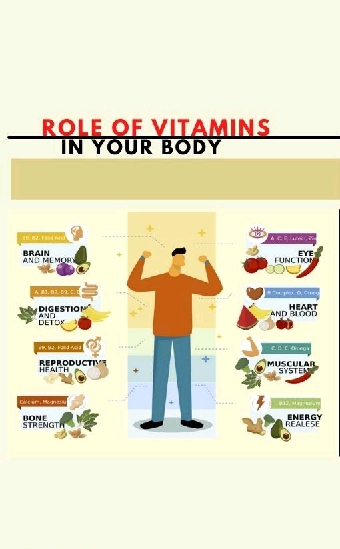
Role of vitamins in your body
MINERALS:
Minerals are inorganic compounds that hold on to their chemical structure. This means that the minerals found in soil and water can easily find their way into your body through the plants, fish, animals, and fluids you consume.
Minerals are important for your body to stay healthy as it performs different jobs for your body such as keeping your brain, heart, muscles, and bones working properly. It's also important for making enzymes and hormones.
There are two types of minerals;
- Macrominerals: These are needed in larger quantities. They include Calcium, Phosphorus, Magnesium, Sodium, Potassium, Chloride, and Sulfur.
- Trace minerals: These are only needed in smaller quantities. They include Iron, Manganese, Copper, Iodine, Zinc, Cobalt, Fluoride, and Selenium.
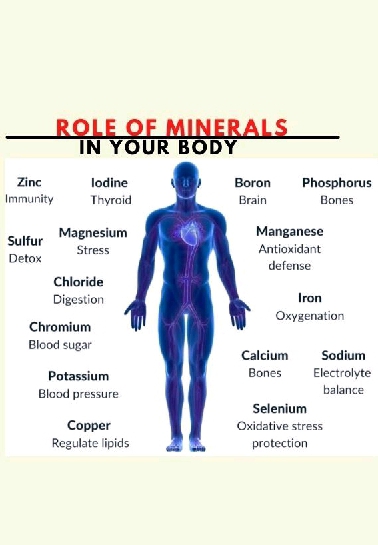
Role of minerals in your body
Conclusion
The role of vitamins and minerals in our body cannot be overemphasized because they are daily essential nutrients that perform a hundred and one functions in our body but there is a fine line between getting enough of these nutrients (which is healthy) and getting too much of these nutrients (which can end up harming you). Again, moderation is the keyword as you can practically get every ounce of mineral and vitamin from the various common everyday meals you consume.Spread the ❤️.
Comments
Post a Comment